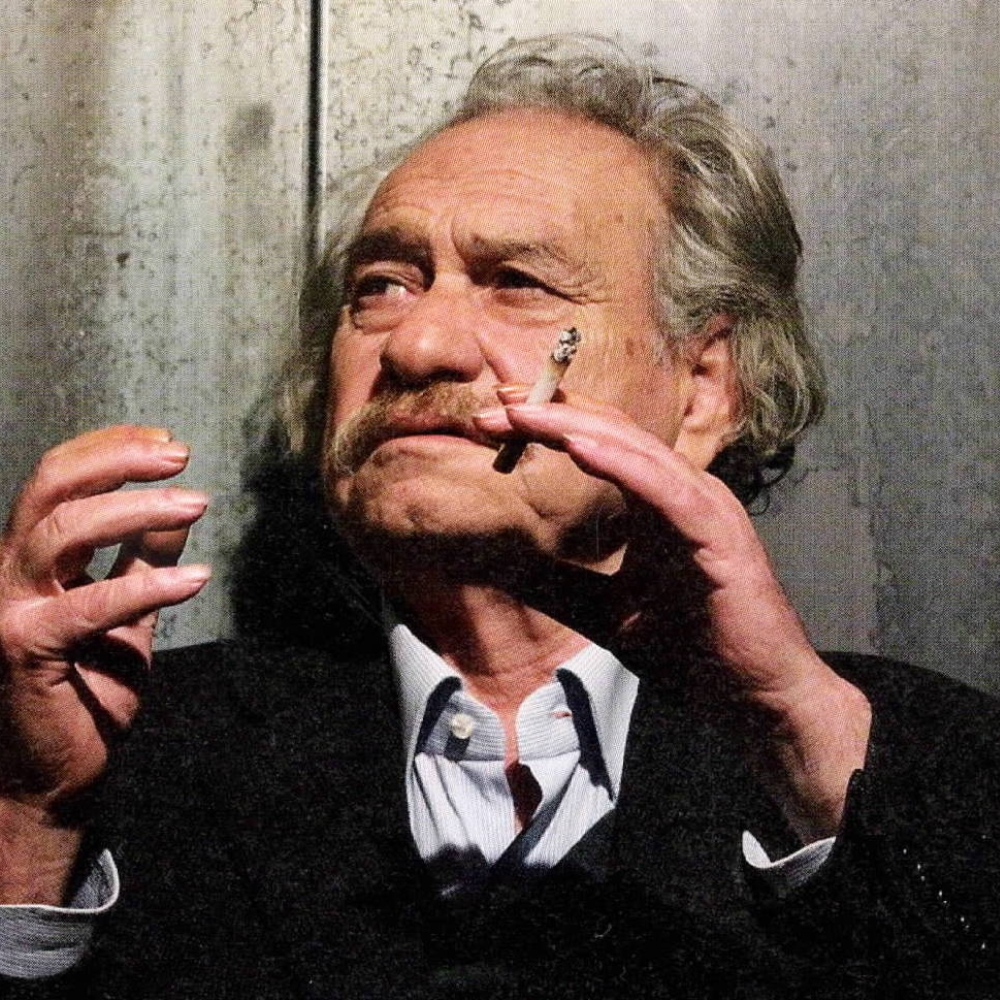
Jannis Kounellis was born in 1936 in Piraeus, Greece, and at the age of 19 he moved to Italy, settling in Rome, where he attended the Academy of Fine Arts. In the late 1950s, he created a poetic language based on a combination of elementary linguistic units such as letters and symbols, painted on white canvas with black tempera, which became the subject of his first exhibition at the Galleria La Tartaruga in Rome. Kounellis is considered one of the fundamental protagonists of Arte Povera, a movement born at the end of the 1960s that revolutionized the language of contemporary art through the use of ’non-noble“ materials and a strong conceptual and environmental component. After a two-year hiatus, he resumed his artistic practice in 1967 and exhibited with artists of the Arte Povera movement at the Attico gallery in Rome, where he exhibited one of his most famous pieces: an installation involving twelve live horses. Over the next ten years, he introduced humble materials into his work, such as canvas, charcoal, wax, iron, lead, and wool, combining them with living natural elements such as animals or plants. Kounellis wanted to invent a new form of language in which nature, culture, and life could communicate. He participated in the historic exhibition ”Live in Your Head: When Attitudes Become Form", curated by Harald Szeemann at the Kunsthalle Bern in 1969, and in 1972 he exhibited at Documenta 5 in Kassel and the Venice Biennale. Kounellis" work gradually became more performative, taking on a more theatrical and musical dimension. From 1992 Kounellis was a professor at the Kunstakademie in Düsseldorf. His works are exhibited at the Pecci Museum in Prato and at MADRE in Naples. Yannis Kounellis died on February 16, 2017 in Rome at the age of 80.


 Italiano
 English (UK)