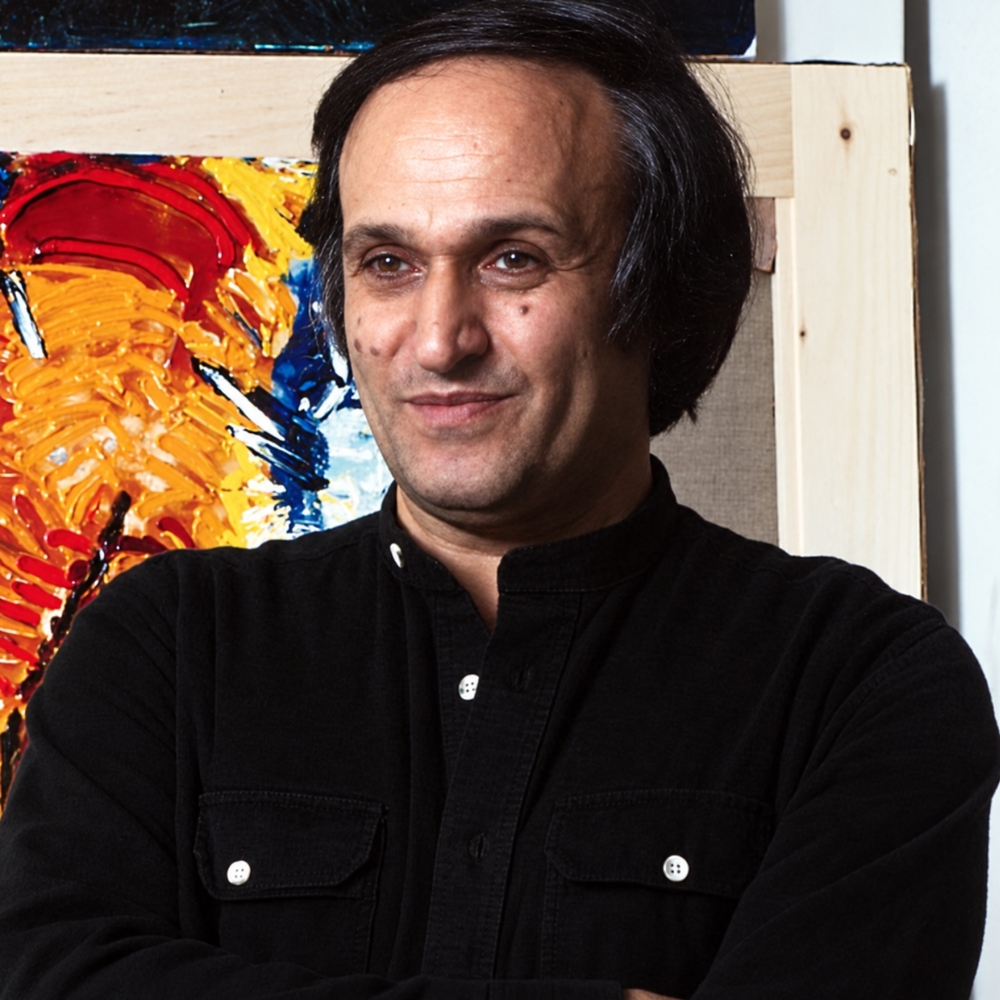
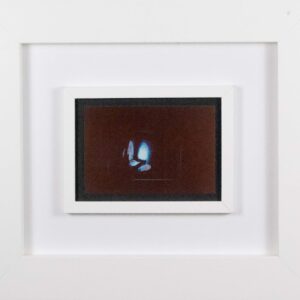
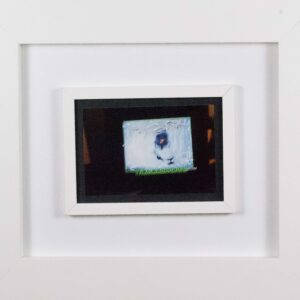
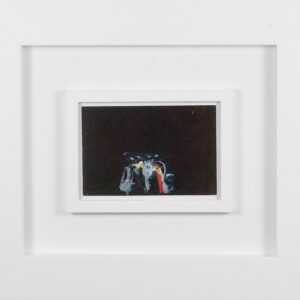
Mario Schifano was one of the most important Italian painters of the second half of the twentieth century; a central figure of Italian Pop Art and postmodern art. Born in Homs (Libya) in 1934, he soon moved with his family to Rome, where he soon began painting after an initial introduction to art working with his father at the Etruscan Museum in Villa Giulia. He debuted with his monochromes in 1960 with an exhibition at the Galleria La Salita in Rome presented by Pierre Restany titled "Five Roman Painters", among whom were Angeli, Festa, Lo Savio, Uncini and Schifano himself. He immediately attracted the attention of critics thanks to his monochromes that offered the impression of a photographic screen and which would later be influenced by Jasper Johns and Robert Rauschenberg. During his artistic career, he signed an exclusive contract with the American gallery owner Ileana Sonnabend and received numerous awards, such as the Lissone Prize in 1961, the Fiorino Prize and La Nuova Figurazione. The following year he made his first trip to the United States, where he met artists such as Frank O’Hara, Jasper Johns and Andy Warhol. He exhibited at the Sidney Janis Gallery in New York in the exhibition The New Realists alongside Andy Warhol and Roy Lichtenstein. In his works, there are increasingly frequent references to the history of Italian art and Futurism. He painted the first Anemical Landscapes that he presented at the Venice Biennale in 1964, gradually moving away from pop aesthetics. These are the years when he began his first cinematic experiments, 16mm black-and-white short films. During this period, he began an exclusive collaboration with the Milanese gallery owner Giorgio Marconi, which lasted until 1970. Schifano participated in international exhibitions such as the Carnegie Institute in Pittsburgh in 1964, the Biennales of San Marino and São Paulo in Brazil in 1965, and the National Museum of Modern Art in Tokyo. He also participated in an exhibition at the La Salita Gallery in Rome where he did not exhibit paintings but projected photographs of the Vietnam War. It is precisely his interest in contemporary history and his civic commitment that led him to an ideological and identity crisis such that he declared that he wanted to abandon painting. This ideological and existential crisis forced him to periods of isolation in his studio where he created works by reinterpreting Magritte, De Chirico, Boccioni, Cézanne, and Picabia. In 1970, he began the series of TV Landscapes where he transferred television images onto canvas using the technique of photographic emulsion. Initially, the photographs taken in the United States with the heart transplant centers in Houston, the NASA laboratories in Alamogordo and Los Alamos are the subject of re-processing. Later, he begins to artistically re-interpret the images broadcast by RAI and other television stations. In the process of creating these works, he uses new industrial varnishes of great brilliance and transparency, capable of drying very quickly, thus allowing him to produce much larger works. In 1971, he exhibits in the exhibition Vitalità del negativo nell’arte italiana 1960-70, curated by Achille Bonito Oliva; his personal exhibitions open in Rome, Parma, Turin and Naples. In 1973, he participates in the X Quadriennale di Roma and in Contemporanea, again curated by Achille Bonito Oliva. In 1974, the Palazzo della Pilotta (Salone delle Scuderie) in Parma hosts his first major retrospective, curated by Arturo Carlo Quintavalle. In 1978 he returned to the Venice Biennale with the series Al mare and Quadri equestri, works painted with extreme grace and lightness that constitute an example of a newfound creative freshness. In 1981 he participated in the exhibition Identité italienne at the Centre Georges Pompidou in Paris. In 1982 and 1984 he was invited again to the Venice Biennale. At the same time, Alain Cueff presented to Piombi the cycle Naturale sconosciuto, where his particular attention to nature emerges. Thus, the Gigli d’acqua, i Campi di grano, le Onde and a series of paintings made with sand for an exhibition on the deserts in Jordan were created. The canvases donated to Gibellina for artistic reconstruction after the earthquake also stem from this new pictorial impulse. In 1990, after a decade of intense painting in which he produced many of his most emotional works, he inaugurated the reopening of the Palazzo delle Esposizioni in Rome with Divulgare, a review of works of exceptional size created using the first digital technologies. The reproduced images combine the reality filtered through television with the dimension of the unconscious. The large works represent the new satellite visions, environmental emergencies, and war. His civic commitment extends to the realization of works in support of the campaigns of Greenpeace, Acnur, and many other volunteer associations. The 1993 Venice Biennale, curated by Achille Bonito Oliva, offers him a personal room in the Slittamenti section. In 1994, he participated in the exhibition The Italian Metamorphosis, 1943-1968, organized at the Solomon R. Guggenheim Museum in New York; in 1996, he exhibited in Spain and Latin America with the exhibition Musa ausiliaria, a tribute to television. The works of these years testify to his renewed interest in technology. The artist is primarily dedicated to photography and multiples his production of series of works using television as a commercial medium. Mario Schifano died at the age of 63 on January 26, 1998 in Rome. His extensive and immense pictorial production is represented by the Mario Schifano Archive, founded in 2003 by the heirs.
Mario Schifano
The works of the'Artist
3 opere trovate
 Italiano
 English (UK)